Seven

Dear Whit,

Today you are seven.  I have loved every age you’ve ever been – that’s really the truth; for example,  I will never be able to adequately express to you the way that your infancy healed so many broken things inside of me.  But right now, you are particularly divine.  You are growing fast but you are still, for now at least, a little boy: you instinctively take my hand when you’re walking next to me, you embrace the world without guile or preconceptions, you tell me daily and sincerely that you love me, you unabashedly adore LEGOs, robots, coloring, and Tin Tin, and you throw your arms around my neck for a full-body hug before bed.

You have a close circle of friends and I’m very proud that they are all very nice kids.  It’s a pleasure to watch you interacting.  Recently I drove you and a friend to a birthday party, and listened to you talking.  You were talking about covering yourself with mud in the Dead Sea, and you realized your friend had seen the photos because his mother is a friend of mine.  “Oh, I need to make sure you know,” you told him earnestly, “I am wearing those pink shorts because I only have girl cousins on my mother’s side and we forgot bathing suits.”  Your friend looked at you like you were crazy.  “So I had to borrow something from one of my girl cousins.”

“Oh, I thought the shorts were cool,” your friend averred, winning my loyalty for the rest of his days.  “Oh, good.”  I could hear you relax.  “Yeah.  I liked them.”  I glanced in the rearview to see you both nodding.  “There’s no such thing as girl colors and boy colors, you know,” you went on.  Your friend agreed, and you went on to declare purple your “second favorite” color.

Though you have an extensive vocabulary, often surprising us with words we had no idea you knew, there are still times I field “what does that mean?” questions.  For example, you recently asked “what is a dork?”  I fumbled a bit, starting with “Well, it’s not really a nice thing to say, kind of a way of saying someone is not really fun.”  You looked confused.  “Well, I’m kind of a dork, too.”  I finished lamely.

“That is not true, Mummy,” you looked at me, shaking your head.  “you are so fun.”

Oh, my little man.  I know you won’t always think this, and I’m trying to really drink in these days that you do.

Your natural state is one of exuberance.  You burst, blond and laughing, into each morning, climbing out of the top bunk where you sleep clutching your monkey, whose name is Beloved. Despite your energy and enthusiasm towards almost everything, you are often cautious and don’t like to do things until you know you can.  I asked Grace what her favorite story about you this year was and she mentioned Storyland.  On our third visit, our second year, you finally agreed to try one of the rides.  On the log ride you sat in front of me, clutching my hands with white knuckles.  After we came down the flume, water splashing all around us, I asked you cautiously what you thought.  I was worried that you’d hated it.  Instead, you turned back to me, your face absolutely lit up.  “Mummy!  At the top of the ride my tummy was full of butterflies!”  That moment was Grace’s favorite of the year, and I admit it was up there for me too.  After that seminal ride you went on almost everything at Storyland, and at Legoland too.

You love hockey and golf, both passions you share with your Dad, and watching the two of you pursue them makes me smile so hard my heart hurts a little.  After a summer in which I worried that you would never read, you are suddenly devouring chapter books, and, most importantly to me, enjoying reading.

Your body is growing angular, your limbs long, and curling into my lap is getting harder and harder.  The scar from your terrifying second anaphylactic reaction has faded from an angry red gash to a flesh-colored one that glints when light hits it, and the Christmas Eve scar right above your eye is fading also.  In the summer your hair is white-blond, and your eyes remain their startling, genetically-surprising blue.

You are the funniest person I know.  Your sense of humor made itself clear early on, but it has blossomed this year.  You make everyone laugh, and it’s the first characteristic that most people notice about you.  More than once people have asked me if I named my children the traits I wanted them to have (grace and wit).  Um, no.  Despite your hilarious bravado, and your little-man swagger (one of your new favorite words), there’s a seam of deep sensitivity that runs through you whose source I think we all know.  You’ve can be hugely sentimental and are aware of loss in a way far more mature than your years.

You’re growing fast, my beloved boy, my first son, my last baby.  You are losing teeth and gaining skills with every passing week.  This summer was full of milestones; I called it the summer of letting go and I was specifically talking about you.  You enlarge my life and bring me more joy and love than I ever thought possible.  You are the drumbeat of my life, and as much as your steady, noisy rhythm sometimes overwhelms me, I beg you never to stop it.  I will never forget the moment that you were born, on a freezing cold Thursday at 3am, after an intense labor that I experienced mostly alone and will always remember as some of the most luminous, empowered hours of my life.  You were blond and blue-eyed and you were, most shockingly of all, a boy.

And thank you, dear universe, for bringing such a marvelous, intractable, delightful, delicious child into my life.  Thank you, thank you, thank you, Whit, for all that you are.

I love you.  Now and always.

The letters on your other birthdays: six, five, four, three, two


Email this post  Email this post

Seven Years Ago Tomorrow

Seven years ago tomorrow.  Cliche alert, but: how?  Cue sobs, weeping, overwhelming love, and intense nostalgia.

January 20, 2005
3:15 am
Samuel Whitman
7 lbs 9 oz
6 days early (and not a dwarf)

“And we are put on earth … That we may learn to bear the beams of love.”
- William Blake


Email this post  Email this post

The light of the heart is blue

Hart

The light of the heart is blue.  It is a blue chamber,
it never ends, a summer night
stretched into dawn through which a deer bounds.

ghostly, calm, turning to regard you
as you stand on the road.  And then
departs, having been held only lightly by the eye.

Everything natural to us must be felt
freely, like the clambering of a vine
through the asphalt towards the sky.

The light of the heart is blue.  It is a blue chamber,
with a painted wall; in its distance a deer bounds
through forest patched by sun.

- Meghan O’Rourke


Email this post  Email this post

In the labyrinth

I am reading Barbara Brown Taylor’s beautiful An Altar in the World right now and loving it.  Several different and disparate people recommended it to me and they were all right.  There are many passages that resonate – most of all the section called “reverence,” which is the best way I know how to describe my instinctive posture towards the world.

In the book’s section on groundedness Brown Taylor writes of the ancient spiritual practice of labyrinth walking and I thought instantly of last spring, when Grace and I went to Kripalu.  Together we walked the labyrinth there, and I was startled by how utterly she seemed to sense the palpable peace and – well, reverence – in the air.  I followed Grace in silence, watching her narrow shoulders, her bobbing ponytail, the little freckle at the base of her neck that I remember noticing when she was only months old.

Just like life, Brown Taylor says, the labyrinth had “switchbacks and detours,” and “the path goes nowhere.”  In fact, “the journey is the point.  The walking is the thing.”  I’ve walked the Kripalu labyrinth twice, once alone, and once with my daughter, and both times I found myself doubting, at a certain point in my passage, that the winding back-and-forth path will ever get me to the center.  The center that I can see so clearly and yet, rule-abider that I am, I refuse to simply walk into. Of course, with a little trust and some forbearance, the path eventually got me there both times.

More importantly, though, there’s no actually no eureka at the center.  There’s a pole which says let peace prevail on earth (I was delighted when I noticed that an identical pole stands in the playground of my children’s school), and some small piles of stones, which remind me of the cairns at Walden.  I stood in the quiet center, my entire being prickling with awareness, and then, after long moments of listening to my own breathing (and Grace’s), set back out again on the winding path.  There’s nothing, really, at the center.

The journey is the point.

I am deep in my own labyrinth right now.  Some unexpected switchbacks and detours are causing my faith in the security of the path waver.   That it isn’t the destination I am doubting is evidence of enormous internal growth for me.  I don’t much care about the destination, anymore – after years and years and years, I’ve honestly and truly let go of that.  But I’m feeling the ground under my feet shaking some, and I don’t like wobbling.  So I’m trying to close my eyes and revisit the labyrinth at Kripalu, hear my own breathing and Grace’s, and put one foot in front of the other.  To remember: the walking is the thing.


Email this post  Email this post

Unadventurous

There is no question that I am the unadventurous sibling.  I’ve mentioned my sister?  The one who is living in Jerusalem for the year, with her two daughters, ages 5 and 3?  Yes, that one. Apparently many boarding school teachers spend their sabbaticals reading books in a hammock at their lake house.  Not so my brother-in-law and my sister.  Instead they moved their small children halfway across the world to the Middle East.  And whoa, am I proud of her.

On the other hand, I have lived in the same house for 11 years.  A house that is a mile from where my children go to school and less than a mile from the house my sister and I were born in.

Hilary and I grew up in the same world; we are from the same terroir.  In fact she’s the only person in the world who was by my side during those formative early years with me.  It is she who was bundled under the seat in front of me (and my mother) on a transatlantic flight when we were 1 and 3.  It is she who’s standing next to me in so many pictures across Europe, with Another Damn Cathedral (ADC) soaring behind us (you can see that I did not inherit my father’s photography skills: in the photo above we’re standing before the Dome of the Rock.  But I chose a less-than-optimal spot for capturing the moment.  Classic.).

Coming as we do from the same particular soil, one that was intense, challenging, and rich, Hilary and I have a great many things in common.  I’ve always thought we look very much alike, a fact that I think is apparent in the photograph above (which redeems it, in my view, from its lack of excellence in the touristy-shot category).

But there are some big differences, and today it’s this one – the appetite for adventure and risk – that’s on my mind.

I’ve long believed that people are more a product of nature than nurture, so who knows how much of Hilary’s and my differences are innate and how much of them come about through our different reactions to the same circumstances.  But regardless, I look at her and T, and think of the extraordinary experiences they are engraving n their daughters’ early memories, and I wonder why it is that I went so thoroughly the other way.

My father has long held that an international adventure is critical for proper family life.  I know I’m a bit of a disappointment, at least on that dimension.  It’s true that my own personal experience of our transatlantic childhood was not unequivocally positive.  I would never do it differently, but for me the back-and-forth across the Atlantic rhythm had some difficult repercussions.  But of course there were tremendous riches, too.  And when I visit Hilary in Jerusalem, and witness all that they are exploring and learning, I recall only the horizon-expanding moments.

I’ll never know why it is that I responded in such an unadventurous way to my childhood.  I regret it, in some ways, but in others I’m doing just what I said I’d do: stay put.  What I find myself thinking now, in the aftermath of our life-changing trip, is of how I can introduce adventure, particularly of the international sort, into our life without fundamentally changing its structure.  Whit’s godmother, one of my oldest friends, is moving to China this month.  I am dreaming of a visit to Beijing.  Stay tuned.

And Hilary, thank you, as always, for ever, for the continued inspiration you provide for me.


Email this post  Email this post

Only light can drive out darkness

Darkness cannot drive out darkness; only light can do that. Hate cannot drive out hate; only love can do that.
Only in the darkness can you see the stars.
Martin Luther King had some good things to say about my current obsession, light.

Last year I posted a few excerpts from MLK’s famous speech, which I make a practice of reading in full on this day every year.  I recommend you do too: his words remain immensely powerful to this day.  Last year, for the first time, Grace and Whit watched the video of him delivering the speech.  They were spellbound, and I plan to watch it with them again today.

…I say to you today, my friends, so even though we face the difficulties of today and tomorrow, I still have a dream. It is a dream deeply rooted in the American dream….

…one day right there in Alabama, little black boys and black girls will be able to join hands with little white boys and white girls as sisters and brothers….

…This will be the day when all of God’s children will be able to sing with a new meaning, “My country, ’tis of thee, sweet land of liberty, of thee I sing. Land where my fathers died, land of the pilgrim’s pride, from every mountainside, let freedom ring.”

Martin Luther King, August 28, 1963


Email this post  Email this post

Great and indelible solitude

The silence must be immense where you are living right now, immense enough to allow such tumult of sound and motion. And if you think that in the ocean’s vastness there exists not only the present moment but reverberations of primordial harmonies, then you can be patient and trust the great and indelible solitude at work in you. This will be a nameless influence in all that lies ahead for you to experience and accomplish, rather as if the blood of our ancestors moves in us and combines with ours in the unique, unrepeatable being that at every turn of our life we are.

- Rainer Maria Rilke, Letter to a Young Poet (Paris, December 26, 1908)

From, again, the beautiful blog A Year With Rilke


Email this post  Email this post

Holiness

We live in all we seek.  The hidden shows up in too-plain sight.  It lives captive on the face of the obvious – the people, events, and things of the day – to which we as sophisticated children have long since become oblivious.  What a hideout: Holiness lies spread and borne over the surface of time and stuff like color.

I went back to my dogeared copy of Annie Dillard’s For the Time Being this week, I’m not sure why.  As I leafed through the familiar pages, these words jumped out at me.  During these days when we wake in darkness and we eat dinner in darkness, when the light is so full of both endings and beginnings, the sun bright yet weak, I am trying to see the holiness spread all over this life of mine.

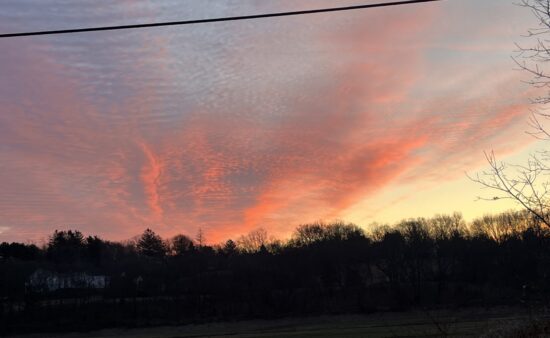
Some days it jumps out and snaps foil in my eyes, waking me up. How can I miss the beauty in this sky, that was spread out above me on a recent walk with Grace?  If that’s not divinity, tangible in this human world of ours, I don’t know what is.

Or this sunset, seen from my desk.  The sky went deep pink, and I took pictures, and then returned to my computer.  And suddenly, for some reason I can’t recall (maybe I heard car doors slamming and the screeches of my children) I looked back out.  And the sky had caught fire.  If I hadn’t looked over, I would have entirely missed it, as the entire show lasted no more than 5 minutes.  It is impossible not to drop to my knees in reverence, not to feel the presence of something that exists beyond logic – over the horizon – in that sky.  And so I do.

Other days I have to be slightly more aware.  When I parked the car the other day, on my way to an interview on a cold early morning, I could not believe how loud the song of sparrows was.  I looked closely and saw that the bush right by the road, barren and brown, was absolutely full to bursting with sparrows.  I tried to take a picture but of course it didn’t quite capture what I saw.  In the midst of all these dead branches, this fallow world, there is song.


Email this post  Email this post

The Underside of Joy

I was thrilled when Sere Prince Halverson, whose wonderful blog I’ve read for a long time, sent me an advance copy of her first novel.  The Underside of Joy, which is available here, is a beautiful story about love in all its myriad shapes and about all the ways that people can be knotted together as family.  Sere’s voice is lyrical and lovely, and The Underside of Joy kept me up way too late in my sister’s apartment in Jerusalem.  I was utterly engrossed in story and deeply invested in the main characters.

Within the first few pages, the protagonist, Ella Beene, is widowed, left alone with her husband Joe’s two children.  Ella has known Zachary, now 3, and Annie, now 6 for three years, since she met their father and almost instantly merged into their family.  When Ella meets Joe and his kids, their mother, Paige, had left four months earlier, in the throes of a deep postpartum depression.  It becomes clear as the story goes on that Ella and Joe both stayed willfully blind to the complexities of Paige’s potential return.  We begin to see, in fact, that Joe’s turning his back on the situation was more than just wishful thinking; it was cruel.

Ella is left with – literally – buried boxes and hidden envelopes full of Joe’s secrets.  She unravels the truth of Paige’s story  even as Paige herself comes back, claiming Annie and Zachary in small and then large ways.  My sentiments were originally entirely with Ella, and yet as I learned more about Paige, about the way Joe rebuffed her sincere efforts to return to her children, about the depth and severity of her depression, she became a sympathetic character in her own right.

The Underside of Joy explores the nature of family but also the meaning of  home. Ella herself had slipped into Joe’s world completely, leaving behind an unhappy marriage filled with the stress of infertility treatments and poor communications.  She finds herself in Northern California, whose particular geographical contours, arching redwood trees and rocky coastline, are powerfully evoked, and inside a family whose warm embrace feels like home.  She – and, we learn later, Paige – comes from a family with secrets of its own, which makes it impossible for her to unequivocally judge Joe for the decisions he made.  In fact, Ella learns of herself: “There was now the undeniable fact that I’d lived much of my life according to that one lesson: Look the other way.  Don’t ask.  Ever.  And good God, don’t say what you really think.”  But what The Underside of Joy traces, ultimately, is Ella’s learning to look into the blackness.  And to say what she really thinks.

As Ella learns to ask, to say, to look, she probes the deepest recesses of the human heart.  How do you define mother?  It is not, we understand, fiercely, merely a matter of blood.  What does loyalty mean, and how do you parse and order those various allegiances when they are in conflict?  How do we reconcile the devoted love we had for someone who died with the ambivalent legacy he left?

Sere is unflinching in her ability to draw complicated, deeply human people.  Everybody stumbles, she asserts, and the best we can do is turn and face our flaws.  Joe, whose spirit haunts the book, is revealed over and over as someone who preferred not to see the ugly marks, the scars, the messiness.  Though we can understand why, and Ella’s response to him is never simplified into frank blame, I can’t help feeling like he is the least likeable person in the book.  Maybe that’s not fair, because he can’t defend himself.  But it is his inability to face the bleakness at the center of those he loves most that leaves both Ella and Paige stranded in a tangled emotional forest. That said, The Underside of Joy refuses to resolve into easy answers, into good and bad.  In the epilogue, Ella looks and Annie and thinks:

What I want to tell her, but what she will have to discover on her own, is that no matter what she chooses to do for her profession, she will save people, and she will also do people grave hard – and they will be the same people, the ones she loves.

There are other subplots to The Underside of Joy, all of them involving legacy and history, the ways where we came from haunt us for better or worse throughout our lives.  The novel’s message echoes: we cannot escape where we came from, but those shadows provide immeasurable depth to the joy of our lives.  The Underside of Joy‘s last paragraph contains these lines, which are so familiar to me that my eyes filled with tears as I read them and my heart thudded with recognition:

I know now that the most genuine happiness is kept afloat by an underlying sorrow.

I cannot recommend The Underside of Joy heartily enough: it is a novel that is as moving as it is entertaining, and I absolutely loved it.


Email this post  Email this post

Light, and the vocabulary of mystery

I have been thinking about light.  Of course I have.  Even more than usual.  MK Countryman sent me a fascinating interview from NPR with Arthur Zajonc, an academic who “bring[s] together physical and poetic understandings.”  Zajonc is a physicist and also a committed meditator, and his practice of contemplation-enriched science really spoke to me (remember, I grew up in the space between science and poetry, and have a strong interest myself in both).

The interview is full of interesting topics.  Zajonc touches on Rudolf Steiner, Goethe, and Einstein.  I highly recommend reading it in full.  A couple of points resonated the most with me.

“But…if you don’t have an object for light to fall on, in fact, we only see darkness.”  Zajonc takes this image and uses it as a metaphor for all of contemplation.  He imagines light to me this kind of meditation, this thinking, this falling into the spirit of things.  Through careful use of this light, “one comes to know the inside of every outside. It’s not only human beings that have an interior or an inside, but that the world around us as well can be known inwardly.  So life is dense with those levels of experience, but we need to calm ourselves, get clear, get quiet, direct attention, sustain the attention, open up to what is normally invisible, and certain things begin to show themselves. Maybe gently to begin with, but nonetheless it deepens and enriches our lives. If we are committed to knowledge, then we ought to be committed also to exploring the world with these lenses, with this method in mind and heart.  You know, otherwise we’re kind of doing it halfway. And then when we go to solve the problems of our world, whether they’re educational or environmental, we’re bringing only half of our intelligence to bear; we’ve left the other half idle or relegated it to religious philosophers. But if we’re going to be integral ourselves, you know, have a perspective which is whole, then we need to bring all of our capacities to the issues that we confront, spiritual capacities as well as more conventional sensory-based intellects and the like.”

This passage is long, but the ideas it contains strike a gong deep inside of me, and remind me that the word light came to me, now, for a reason.  The internal light, brought to bear on our experience, can help us knit together the worlds of the intellect and the spirit.  And it is in this combination that the true meaning of our life here on earth is found.

Zajonc talks about another important duality: “colors come in to being through the interaction or the conflict or the meeting of light and darkness.”  This makes me think of my own musings on light and shadow, and of my belief that it is in the shadows that the most important and interesting insights are found.  Where light borders darkness, in the liminal corners of life.  These are the places I am drawn to, the places I find the most richness.

I think part of why I like the light this time of year, or in summer evenings, is that I can actually see the light.  As opposed to most of the time, when light – unless you look incredibly closely, and have a finely-tuned eye, which I’m not sure I do – is invisible, illuminating all that we see without getting involved.  This is why I love my photograph of the setting sun on the Church of the Nativity.  I love moments when light itself is a participant in my experience, because they remind me of the immense power of something that is often so invisible.  Invisible, and yet crucial, to our sight.

At the end of the interview, Tippett asks Zajonc about his “vocabulary of mystery.”  I adore this image, and wonder if it isn’t another, more poetic way to describe what I keep writing and searching for, so fumblingly, about here.


Email this post  Email this post